Short answer: Uniform rental vs purchase comes down to who owns the garments and who looks after them. With rental, a provider supplies and cares for them for a recurring fee. With a purchase, you own them and run the upkeep yourself. Compare the full cost over the same period, and read the fine print, before you choose.
Key takeaways
Ownership drives everything else. Who owns the garments decides who launders, who replaces and who controls the design.
Compare over the same period. A low monthly fee and a bigger upfront order only compare fairly across the same number of years.
Read the contract before the price. Term, renewal, exit and fee clauses change the real cost more than the headline number does.
Neither one always wins. Rental fits some teams better, and I’ll say which ones.
Most teams don’t choose between renting and buying on purpose. Someone signs a rental agreement to fix a shortage, or one site buys polos from a local shop, and the program drifts from there. Then a renewal notice or a new site forces the rental vs purchase question.
I wrote this for operations, procurement and facilities managers who have to make that call across several sites or roles. Carcilo supplies factory-direct uniforms, so I lean toward owning garments. I’ll show where rental genuinely wins, and you can test both with your own numbers. If you already know you want to own, our corporate uniforms page shows what we make. Already have a rental invoice to compare? Ask for a comparison quote.
What is the difference between renting and buying uniforms?
With rental, a provider owns the garments and rents them to you. With buying, you own them from the day they arrive. That one difference decides who launders, who replaces worn items and how much say you have over fabric and fit.
Some suppliers sell rental as an employee uniform rental service, and a few call it a uniform lease. The idea is the same: you pay to use garments you don’t own.
How does a uniform rental program work?
A provider supplies garments in your employees’ sizes, collects them for cleaning and returns fresh sets, usually on a set schedule. You pay a recurring fee, and the provider replaces worn items under the agreement’s terms.
A uniform rental program suits teams that want cleaning and replacement handled for them. The tradeoff is that you rent the whole service, so the fee runs for as long as the agreement does. Rental work uniforms also tend to come from the provider’s catalog, which limits how far you can customize them.
How does a uniform purchase program work?
You specify the garments, place an order and own what arrives. A uniform purchase program moves laundering, replacement and reorders to you or a vendor you choose. In return, you control the spec, and the garments stay yours if you change suppliers.
Buying costs more upfront and asks for more planning. You need sizes, a replacement plan and someone who owns the next order. How many sets each person needs, and when to replace them, is covered in my uniform program guide.
Uniform rental vs purchase: how do they compare side by side?
| Rental | Purchase | |
|---|---|---|
| Who owns the garments | Usually the provider | You |
| Laundering | Usually included in the fee | You, or a vendor you choose |
| Replacement | Handled under the agreement | You reorder, on your schedule |
| Upfront cost | Low, mostly setup | Higher, because you buy the garments |
| Cost over time | A recurring fee for as long as the agreement runs | One purchase, plus laundering and replacements |
| Contract | Multi-year terms are common | Usually none beyond each order |
| Design control | Mostly the provider’s catalog | Fabric, fit and decoration are yours, within what can be produced |
| Size changes | Handled by the provider, sometimes for a fee | You reorder the size you need |
| Best for | High turnover, or no way to launder | Steady roles, several sites, custom branding |
Want a purchase quote to set next to your rental invoice? Send us your spec.
How much does uniform rental cost, and what should you count?
Start with the recurring fee, then add everything around it. Uniform rental cost usually includes the fee per employee, setup or logo charges, and possibly fees for size changes, lost or damaged garments, or minimum usage. Ask each provider to list them, and ask how the fee can change during the term.
Count buying the same way: garment price with decoration, freight, laundering, replacements, reorder minimums and the time your team spends managing orders. A cheaper garment that wears out sooner can cost more over a year than a better one. For the tax treatment of uniform costs, talk to a qualified professional.
Which is cheaper, renting or buying uniforms? A break-even worksheet
Neither always wins, so compare buying vs renting uniforms over the same period, such as the length of the rental agreement. Fill in your own numbers from real quotes. I left the boxes empty on purpose, because your figures matter more than mine.
| Line | Rental | Purchase |
|---|---|---|
| Period you are comparing | Same for both | |
| Employees covered | A | |
| Recurring fee per employee, times periods | B | |
| Setup and logo charges | C | |
| Expected size, loss or damage fees | D | |
| Garment cost with decoration, times sets per employee | E | |
| Freight and reorder handling | F | |
| Laundering, yours or a vendor’s | G | |
| Expected replacements over the period | H | |
| Total | B + C + D | E + F + G + H |
The lower total wins on cost. Then weigh what the number leaves out: how flexible the contract is, how much control you have over the spec, and how much management time each option takes.
What should you check in a uniform rental contract?
Read the uniform rental contract, also called a uniform rental agreement, before you compare prices, because the clauses change the real cost. Ask for these in writing.
| Check | Why it matters |
|---|---|
| Term and auto-renewal | Some agreements renew unless you cancel inside a set window. |
| Early exit | Know the cost and the process before you sign, not after. |
| Price changes | Whether the fee can rise during or after the first term. |
| Extra fees | Size changes, lost or damaged garments, setup, logo digitizing and minimum usage. |
| Garment return | What must come back, and in what condition, when you leave. |
| Logo artwork | Whether you can reuse your artwork with another supplier. |
| Provider changes | What happens to your agreement if the provider is sold or hands it to someone else. |
| Adding sites | Whether new locations get the same terms. |
Have your procurement or legal team review the final agreement.
When does renting make more sense?
Rental is the better fit in a few cases, and I’d rather say so than sell you the wrong thing. It works well when you have no way to launder garments, when headcount turns over often, or when you only need uniforms for a short period. It also suits teams that don’t want to hold inventory or track replacements.
If laundering is your biggest headache, rental usually solves it, and we don’t.
When does buying make more sense?
Buying fits teams with steady roles, several sites and a spec they want to control. You choose the fabric, fit and logo placement, and one master spec keeps every site matched. You can also reorder from any supplier that can work to your spec. That’s the case for corporate uniform programs, where consistency across locations matters more than convenience. Budget for a cleaning plan and someone who owns reorders.
Can you mix rental and purchase?
Yes, and plenty of teams do. You might rent for high-turnover roles that need frequent swaps, and buy where fit, fabric or branding matters more, such as outerwear or embroidered pieces. The rental vs purchase choice doesn’t have to be all or nothing. Keep one owner for both so the standards don’t drift.
What if the garments are safety apparel?
Not every uniform is PPE, so ask your safety lead first. OSHA’s PPE rule, 29 CFR 1910.132(h)(1), says protective equipment used to comply must be “provided by the employer at no cost to employees,” and 1910.132(a) requires it to be maintained in a sanitary and reliable condition. If a role needs high-visibility workwear or another protective garment, settle who supplies and maintains it under either model, and confirm the details with your safety professional. For electrical hazards, our guide to arc rated vs flame resistant clothing shows how to verify a supplier’s claims.
How do you switch from rental to purchase?
Switch at the end of your term, not in the middle of a shortage. Start early enough to sample and order before the agreement ends.
Send your new supplier the current spec: garment list, fabric weight, colors, logo placement and a size list. Ask for a sample to compare against what people wear now, and pilot at one site first. Bulk production with us typically takes up to 4 weeks after sample approval, depending on order size and specification, confirmed at quote, so plan an overlap. Check your agreement for what must be returned. A uniform manufacturer can build to that spec.
From the Factory Floor: what buying from us looks like
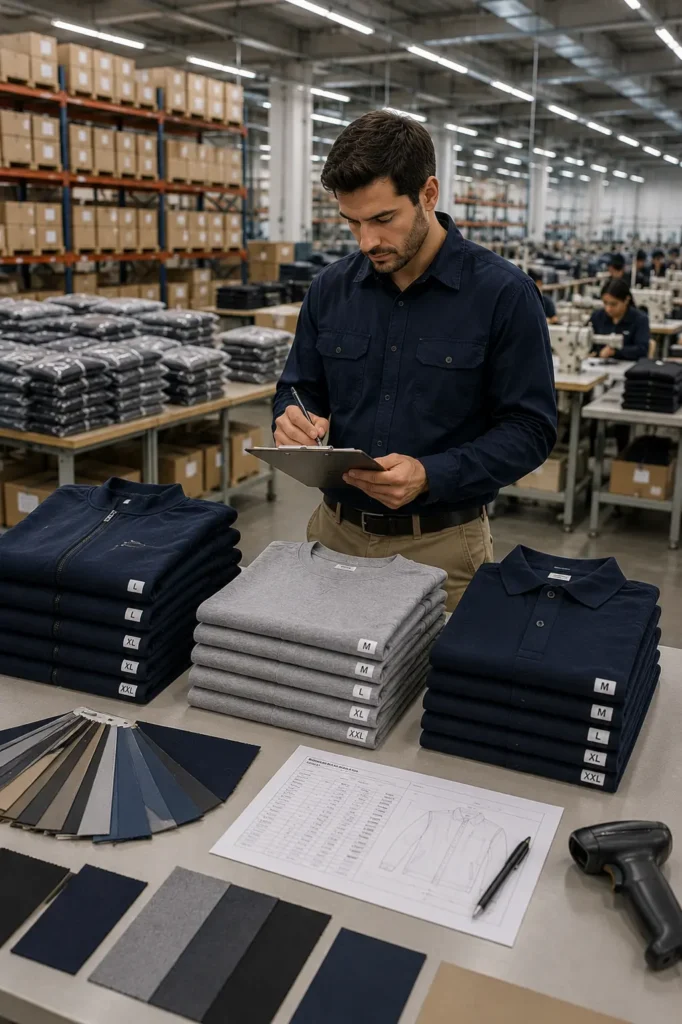
Before the first production run, we lock the garment specification on a spec sheet. Logo placement, thread color and labels are confirmed at sample approval and carried into every run, and later reorders are built from that same sheet. Our minimum is 100 units per style, and we don’t launder garments. Fabric testing is arranged per bulk order, matched to what the program needs.
What do you send to get a quote?
Put your roles or garments, estimated quantity per style, logo or decoration details, target delivery month and ship-to state in the message. We’ll send back a quote built to your specification, so you can set it next to your rental invoice. Not sure what to specify? Start with our uniform range.
Frequently asked questions
What is uniform rental?
A service where a provider supplies, launders and replaces garments for a recurring fee, and you wear them without owning them. Terms, fees and garment options vary by provider.
Is it cheaper to rent or buy uniforms?
It depends on your headcount, turnover, contract length and how you handle laundering. Run the break-even worksheet above with real quotes from both sides, and compare them over the same period.
How long is a uniform rental contract?
Terms vary by provider. Multi-year terms with automatic renewal are common enough to be worth checking. Ask for the term, the renewal window and the exit process in writing before you sign.
How often should uniforms be replaced?
When they are worn, damaged or no longer fit the job, rather than on a fixed calendar date. For safety roles, follow the guidance that comes with the garment and the standard that applies, and confirm with your safety professional.
Does Carcilo handle laundering?
No. We produce garments to your specification. Laundering and replacement scheduling stay with you or your own vendor.
What is the minimum order if you buy from Carcilo?
For Carcilo it is 100 units per style, not per size. Bulk production typically takes up to 4 weeks after sample approval, depending on order size and specification, and we confirm it at quote.
Sources
Author: Moaaz Khalid, Founder, Carcilo. Last reviewed: September 30, 2026. Minimums, the spec-sheet process and laundering describe how Carcilo works. Statements about rental fees, terms and contracts describe common patterns that vary by provider, so check each agreement.