Short answer: Arc rated vs flame resistant clothing is not a choice between two labels. Flame resistant fabric resists ignition and stops burning once the flame is gone. The arc rated version adds a tested rating, in cal/cm², for electric arc exposure. For electrical work you need the rating, so verify it before you buy.
Key takeaways
Arc rated vs flame resistant clothing is not one label. Only an arc rating gives you a tested number to match against your hazard assessment.
Read the number, then ask for the proof. A rating on a label means little without a test report for that fabric.
Know the conformity route. Trade reports on the 2027 NFPA 70E say a bare supplier statement is no longer enough.
Keep reorders on the same specification. A change of fabric or mill needs retesting.
Buyers of protective workwear hear “flame resistant” and “arc rated” used as if they mean the same thing. The gap between them is where supplier claims get loose. A quote can say the right words while the paperwork behind it says very little.
I wrote this for safety, procurement and operations managers who buy for electrical and utility crews. It explains arc rated vs flame resistant clothing, and what to ask a supplier to show you. If you already have a rating in mind, our arc flash protective clothing page shows what we manufacture.
What is flame resistant clothing?
Flame resistant clothing is made from fabric that resists ignition and stops burning once the flame is removed. Clothing that ignites or melts can make an injury worse.
That is why OSHA’s rule for electric power work, 29 CFR 1910.269(l)(8)(iii), bars clothing that could melt or ignite and continue to burn when exposed to flames or electric arcs. The employer has to assess the exposure and estimate the incident heat energy. Our flame resistant work clothing page covers the garments built for this.
What is arc rated clothing?
Arc rated clothing carries a rating from testing that shows how much arc energy the fabric handled. The rating is reported in calories per square centimeter, written cal/cm², and printed on the label. Incident energy is the heat energy a worker can be exposed to at a given distance from an arc. You match the garment’s rating to that number.
ASTM F1506-22 is the performance specification for flame resistant and electric arc rated protective clothing. It covers the arc rating and flame resistance of fabrics, plus garment construction and labeling.
What do arc rating ATPV and EBT mean?
Two measures sit behind the number on a label. ATPV, the arc thermal performance value, is the incident energy at which there is a 50% chance of a second-degree burn. EBT, the energy breakopen threshold, is the energy at which the fabric breaks open. Under ASTM F1506 only the lower of the two goes on the label, so the arc rating ATPV figure you see may really be an EBT value.
Ask the supplier which one the number is. A fair supplier answers that in one line.
Arc rated vs flame resistant clothing: what is the difference?
| Flame resistant | Arc rated | |
|---|---|---|
| What it tells you | The fabric resists ignition and stops burning when the flame is removed | How much arc energy the fabric was tested against, as a number |
| How it shows up | A claim, a label or a fabric spec | A rating in cal/cm² on the label |
| Standard that covers it | Covered alongside arc rating in ASTM F1506 | ASTM F1506, with the arc rating reported from testing |
| Enough for electrical arc work? | Not by itself, because there is no tested arc value | Only if the rating meets your hazard assessment |
| What to ask for | Flame resistance test data for the fabric | The rating, the test report and the conformity route |
So is arc rated clothing flame resistant? Yes, because ASTM F1506 covers both in one specification, so ask the report to show both. The reverse does not hold. A flame resistant shirt with no tested rating tells you how it behaves near a flame, not how much arc energy it can take.
Flash fire protection is a separate hazard, and NFPA 2112 is the standard usually named for it. Your safety lead should say which hazards your assessment calls for. If flame resistance alone fits, see our flame resistant work clothing.
When is arc rated clothing required?
It is required when your hazard assessment finds an arc hazard that clothing has to protect against. OSHA 29 CFR 1910.132(d)(1) requires employers to assess the workplace for hazards and choose PPE to match. Under 1910.132(h)(1), PPE is provided at no cost to employees, with limited exceptions.
For specifics, many employers turn to NFPA 70E, which is where the typical arc flash clothing requirements and NFPA 70E PPE requirements discussions start. I’m not a safety engineer, and none of this is compliance or legal advice. Your safety professional decides what applies at your sites, and our uniform manufacturer page explains what we can build to that spec.
How do you verify a supplier’s arc rated claims?
Your arc flash clothing requirements come from your hazard assessment, and the supplier’s paperwork has to match them. Treat the label as the start of the check, not the end. Ask for these items in writing before you order, and file the answers with your quote. The same checks apply when you buy arc flash protective clothing from us, and I expect buyers to run them.
| Ask for | Why it matters | Red flag |
|---|---|---|
| Arc rating in cal/cm² | It is the number your hazard assessment is matched against. | A range, or “arc rated” with no number. |
| ATPV or EBT | The label reports whichever value is lower. | The supplier can’t say which one the number is. |
| Test report for this fabric | It shows the rating belongs to the fabric you are buying. | A report for a different fabric, weight or color. |
| Standard and edition on the label | The standard should be named, and you should know which edition. | A standard named with no edition or report behind it. |
| Conformity route | It shows who vouches for the claim. More on this below. | A bare statement from the supplier, with nothing behind it. |
| Composition and care label | Care instructions protect the garment’s performance. | No care label, or a label that doesn’t match the tested fabric. |
| Components | Ask whether thread, labels and closures were part of what was evaluated. | No answer, or “it’s all the same.” |
| Reorder consistency | The next run should match the tested specification. | A different fabric lot or mill with no retest. |
A supplier who answers all eight quickly has probably done the work. One who dodges the test report question has told you enough.
Want a specification and quote built around these checks? Send us your spec.
What changes with the 2027 NFPA 70E?
This section relays trade reporting, not NFPA’s own text, so read it as a pointer. Incident Prevention reports that the 2027 edition of NFPA 70E, issued April 16, 2026, removes the pure supplier self-declaration option for arc rated PPE conformity assessment. Two routes remain.
One is self-declaration backed by a registered quality management system and testing at an accredited laboratory. The other is third-party certification by a body accredited to ISO/IEC 17065. The same reporting says manufacturers must show which route they used. Electrical Contractor magazine covers the Article 130 changes as well.
Confirm the final wording against your copy of the standard before you write it into a spec. If your program follows NFPA 70E PPE requirements, ask which route your supplier uses and what document proves it.
How long do arc rated garments last?
There is no calendar answer I can point to. Follow the garment manufacturer’s care and retirement guidance, and inspect garments on a schedule your safety lead sets. Our uniform program guide covers sizing and replacement planning for a wider program.
What is the bottom line on arc rated vs flame resistant clothing?
Ask what is flame resistant clothing, and the answer describes behavior near a flame. Arc rated gives you a tested number and a paper trail. For electrical crews, buy on the number and the proof.
From the Factory Floor: what we confirm before bulk production
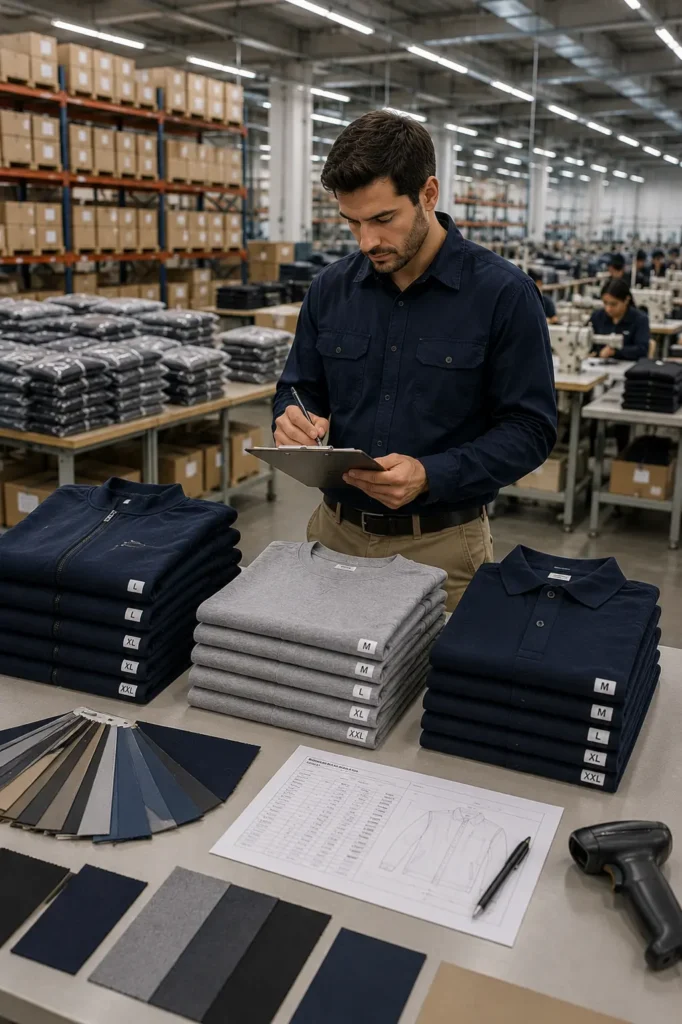
Fabric and arc rating are matched to the hazard class you specify, and we confirm them at sampling, before any bulk order runs. The approved specification is locked, so reorders are built from the same sheet. Carcilo arranges fabric testing and certification matched to your program’s requirements per bulk order. Our minimum is 100 units per style.
What do you send to get an arc rated quote?
Send the garments you need, the arc rating your hazard assessment requires, estimated quantity per style, logo or labeling details, target delivery month and ship-to state. We’ll build a quote to that specification. Bulk production typically takes up to 4 weeks after sample approval, depending on order size and specification, and we confirm it at quote. For arc-rated programs, start with our arc flash protective clothing range.
Frequently asked questions
Is arc rated clothing flame resistant?
Yes. ASTM F1506 covers flame resistance and arc rating in one specification, so the two are tested together. Ask the supplier for the test report, and check that it shows both.
Is all flame resistant clothing arc rated?
No. Flame resistant fabric resists ignition and stops burning once the flame is gone, but it only carries an arc rating if it was tested for one. If the label shows no cal/cm² value, treat it as flame resistant only.
Is flame resistant the same as flame retardant?
The two terms get used loosely in marketing. What matters is the tested result, so ask for the flame resistance and arc rating test data for the exact fabric, whether the flame resistance comes from the fiber or a finish, and the care instructions that protect it.
When is arc rated clothing required?
When your hazard assessment finds an arc or flame hazard that clothing has to protect against. OSHA 1910.132(d)(1) requires the assessment, and 1910.269(l)(8)(iii) bars clothing that could melt or ignite for covered electric power work. Confirm the requirement with your safety professional.
Does arc flash clothing expire?
I’m not aware of a fixed calendar expiry in the standards cited here. Follow the garment manufacturer’s care and retirement guidance, and pull garments that are damaged, contaminated or worn through. Confirm the rules for your site with your safety professional.
How often should arc flash clothing be replaced?
When it wears out, gets damaged or stops fitting properly, not on a set date. Inspect garments on a schedule your safety lead sets, and keep reorders tied to the same tested specification. Our uniform program guide covers replacement planning for other garments.
Sources
- OSHA, Electric Power Generation, Transmission, and Distribution, 29 CFR 1910.269
- OSHA, Personal Protective Equipment, General Requirements, 29 CFR 1910.132
- ASTM F1506-22, Standard Performance Specification for Flame Resistant and Electric Arc Rated Protective Clothing Worn by Workers Exposed to Flames and Electric Arcs
- Tyndale, Arc Ratings for FR Clothing: ATPV and EBT (trade source)
- Incident Prevention, 2027 NFPA 70E: Arc-Rated PPE Conformity Assessment Update (trade source)
- Electrical Contractor, Changes to Article 130: 2027 NFPA 70E update, part 2 (trade source)
Author: Moaaz Khalid, Founder, Carcilo. Last reviewed: October 1, 2026. Minimums, sampling and the spec-sheet process describe how Carcilo works. The NFPA 70E 2027 section relays trade reporting and is not compliance or legal advice. Check the standards and your hazard assessment with a qualified safety professional.